
Hull Pottery Beehive Dishes: A Complete Guide to the 300 Line Kitchen Ware

If you collect vintage American pottery, chances are you have seen one of these wonderfully ribbed bowls hiding on an antique store shelf.
Creamy ivory pottery. Strong horizontal ribs. Simple bands of green, blue, red, or black. Mixing bowls that nest beautifully. Little covered dishes that look almost like miniature beehives.
Collectors commonly call them Hull Beehive dishes or Hull Beehive bowls, but there is much more to this line than the familiar nesting bowls.
Original A. E. Hull Pottery Company literature identifies these pieces as 300 Line Kitchen Ware.
And the line was surprisingly extensive.
Hull made bowls, deep bowls, bake dishes, jugs, ramekins, pie plates, covered casseroles, custard cups, French casseroles, plates, baked-apple dishes, and covered bean pots. All as part of the same coordinated kitchenware line.
Using original Hull material, including a price list dated October 1, 1935, this guide documents the known forms, sizes, factory numbers, and stripe colors of Hull's 300 Line.
If you collect Hull Beehive pottery, are trying to identify a piece, or simply love vintage kitchenware, I hope this page becomes a useful reference.

What Are Hull Pottery "Beehive" Dishes?
One of the most important things to know about this pottery is that "Beehive" is the name collectors commonly use today, while Hull's period literature identifies the pieces as 300 Line Kitchen Ware.
It is easy to understand where the nickname came from.
The horizontal ribs circling the bowls, casseroles, pitchers, and covered pieces give them the stacked-ring appearance of an old-fashioned beehive.
But knowing the 300 Line designation opens up an entirely different way to research and collect them.
If you search only for "Hull Beehive bowls," you might get the impression that Hull simply produced sets of ribbed mixing bowls.
The original literature tells a different story.
This was an entire kitchenware line.

A Brief History of A. E. Hull Pottery
The A. E. Hull Pottery Company began production in Crooksville, Ohio, in 1905 under the leadership of Addis Emmet Hull.
Like many of the important Ohio potteries of the period, Hull benefited from southeastern Ohio's long pottery-making tradition, available clay resources, transportation, and an experienced workforce.
Early Hull production included practical household pottery along with decorative wares. During the following decades, the company grew into one of the better-known names in American pottery.
Hull was already producing art pottery by the late 1910s and expanded significantly during the 1920s. Eventually, the company became known for everything from useful kitchenware to colorful art pottery, florist ware, novelty pieces, and the collectible lines many Hull enthusiasts recognize today.
Long before many of Hull's later floral and decorative pieces were produced, however, the company was making useful pottery intended for everyday American kitchens.
The 300 Line is a wonderful surviving example of that earlier utilitarian side of Hull.

Hull survived dramatic changes in the pottery industry, including a devastating factory fire in 1950. Production resumed after the plant was rebuilt, and Hull continued making pottery for several more decades before the company ultimately closed in 1986.
Today, Hull is remembered for many famous decorative lines, but its practical kitchen pottery deserves attention too.
When Were Hull Beehive Dishes Made?
One of the best pieces of evidence for dating Hull's 300 Line is the surviving company material reproduced here.
The price list is specifically dated:
October 1, 1935
That gives us firm documentation that the Hull 300 Line Kitchen Ware was being offered by 1935.
Even more valuable to collectors, the page provides the original Hull numbers, sizes, item names, stripe colors, and wholesale prices.

What the 1935 Literature Tells Us
This single page answers several questions collectors still ask today.
It confirms that these pieces were part of the 300 Line Kitchen Ware.
It documents dozens of individual sizes and forms.
And it gives us the original names Hull used for the stripe colors.

Even better, the original photograph identifies many of the individual forms by number.

The Original Hull 300 Line Stripe Colors
The October 1, 1935 price list identifies four stripe colors:
Pimento Red
Nubian Black
Spring Green
Alice Blue
The price list also gives us a fascinating manufacturing detail.
The Pimento Red and Nubian Black stripes are described as overglaze decoration.
The Spring Green and Alice Blue stripes are described as underglaze decoration.
That difference may help explain why surviving examples can age differently and why the colored bands on some pieces show more wear than others.
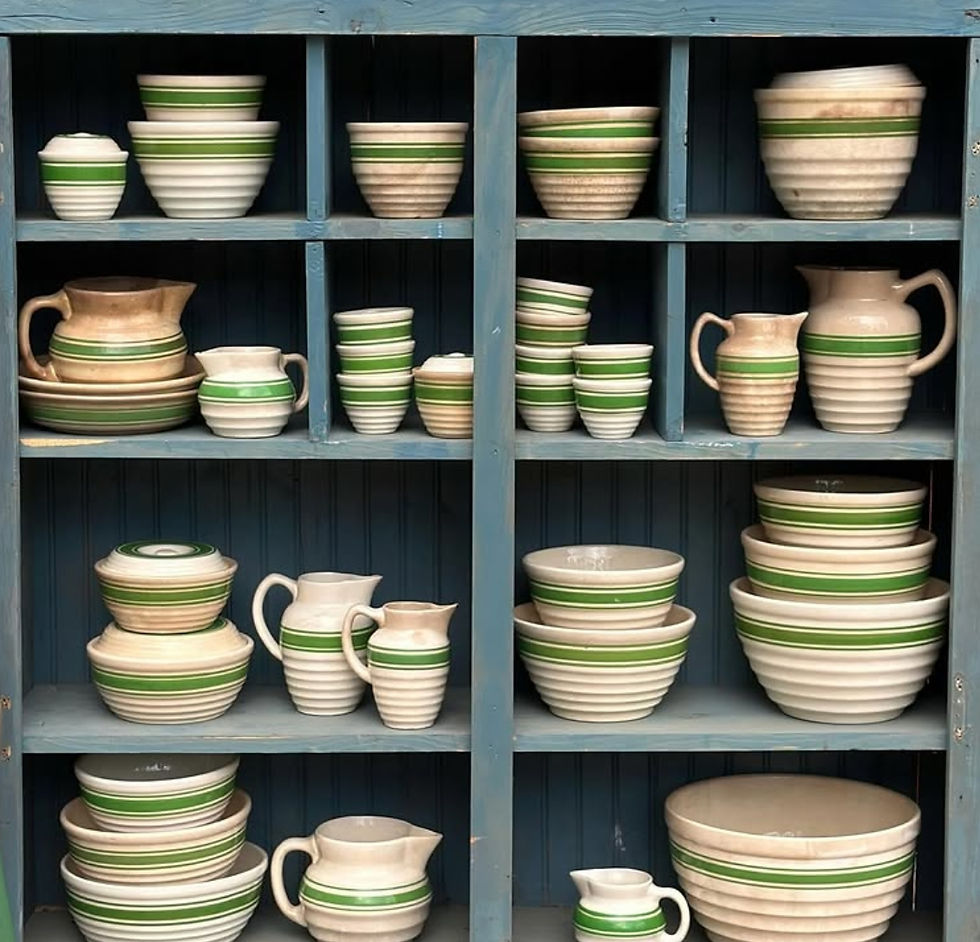
Spring Green
The green stripe is one of the most recognizable versions of the 300 Line today.
Alice Blue
Blue-striped examples are equally attractive and can be particularly striking against Hull's warm ivory body.

Collectors and sellers may use slightly different color descriptions today, especially after decades of fading, glaze changes, lighting differences, and wear.
For identification purposes, however, Pimento Red, Nubian Black, Spring Green, and Alice Blue are the documented Hull color names shown in the 1935 material.
Complete Hull 300 Line Kitchen Ware Master List
This is the part of the guide I would have loved to find when I first started researching Hull Beehive pottery.
The following list is taken from the October 1, 1935 Hull price list shown above.
It documents 12 different forms and 34 individual size/form combinations.
Hull Number | Item | Documented Sizes |
300/1 | Bowl | 5", 6", 7", 8", 9" |
300/4 | Deep Bowl | 4", 5", 6", 7" |
300/6 | Bake Dish | 4", 5", 6", 7", 8", 9" |
300/7 | Jug | ¾ pint, 1 pint, 1 quart |
300/9 | Ramekin | 4" |
300/12 | Pie Plate | 9", 10" |
300/13 | Covered Casserole | 6", 7", 8" |
300/14 | Custard Cup | 3" |
300/15 | French Casserole | 4", 5" |
300/16 | Plate | 7" |
300/17 | Baked Apple | 5" |
300/19 | Covered Bean Pot | 3", 4", 5", 6", 7" |
If you are trying to complete a Hull Beehive collection, this list shows just how ambitious that project can become.
Finding a green mixing bowl is one thing.
Finding every documented bowl, deep bowl, bake dish, jug, ramekin, pie plate, casserole, custard cup, French casserole, plate, baked-apple dish, and bean pot is something entirely different.
Hull No. 300/1 — Bowl
Documented sizes: 5", 6", 7", 8", and 9"
These are the classic nesting bowls most collectors immediately recognize as Hull Beehive bowls.
Five sizes were documented in the 1935 price list, allowing the bowls to nest into attractive graduated sets.
Hull No. 300/4 — Deep Bowl
Documented sizes: 4", 5", 6", and 7"
The Deep Bowl was cataloged separately from the regular Bowl.
That distinction is important as they are taller and they do not have the rim for a lid.

Hull No. 300/6 — Bake Dish
Documented sizes: 4", 5", 6", 7", 8", and 9"
The Bake Dish was available in an impressive six sizes.
These are your shorter "mixing bowls".
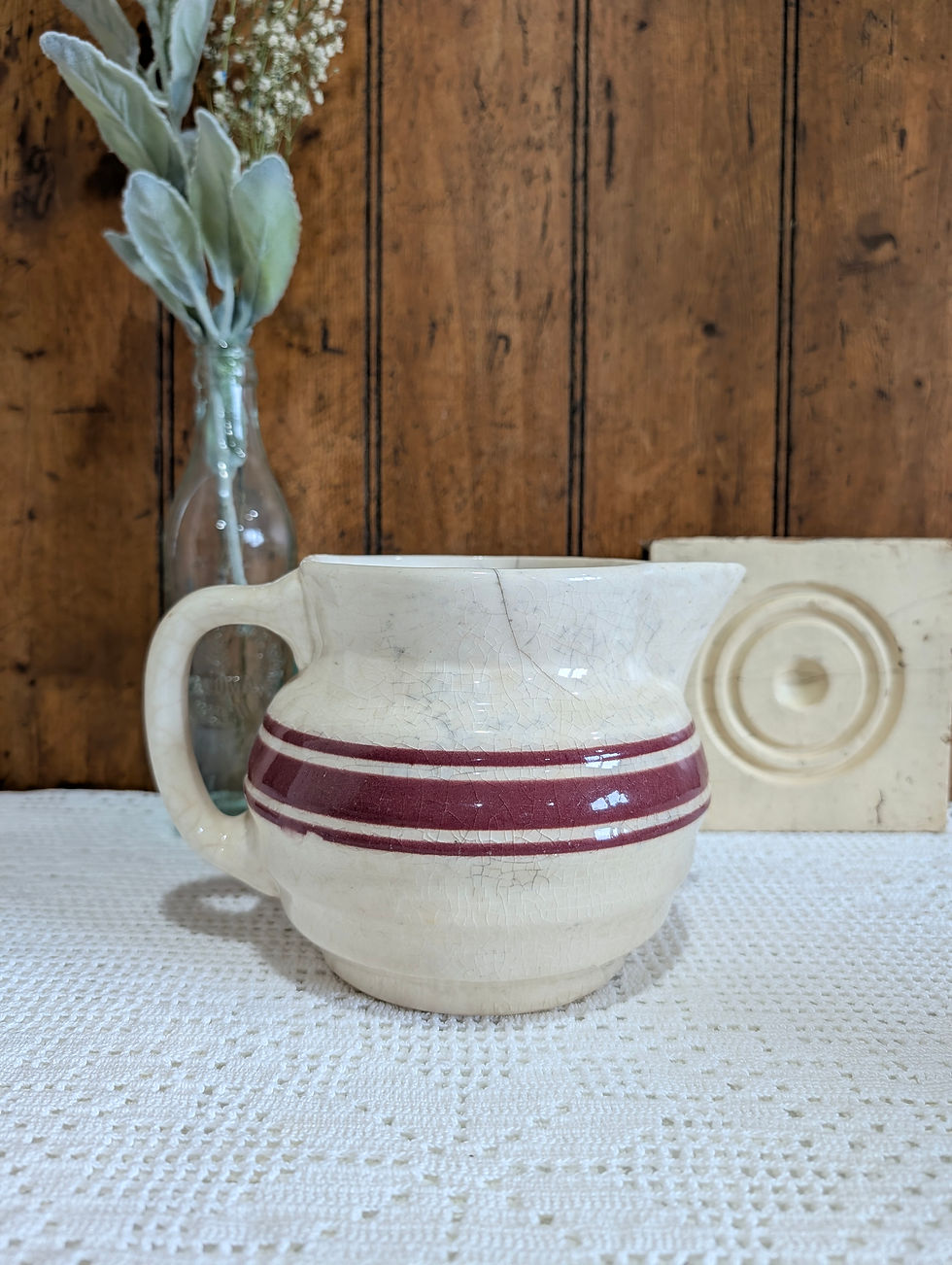
Hull No. 300/7 — Jug
Documented capacities: ¾ pint, 1 pint, and 1 quart
Hull offered the Jug in three capacities.
These pitchers have wonderful proportions, combining the ribbed lower body with a smoother shoulder, pouring lip, and handle.
When displayed alongside the bowls, the family resemblance is obvious.
Hull No. 300/9 — Ramekin
Documented size: 4"
The little 4-inch Ramekin is exactly the kind of piece that can be overlooked when people think of Hull Beehive pottery only as mixing bowls.
Hull No. 300/12 — Pie Plate
Documented sizes: 9" and 10"
Hull offered two sizes of Pie Plate.
Hull No. 300/13 — Covered Casserole
Documented sizes: 6", 7", and 8"
The Covered Casserole is one of the forms that best demonstrates why the "Beehive" nickname feels so appropriate.
The lid continues the strong circular lines of the ribbed body, producing a compact stacked appearance.
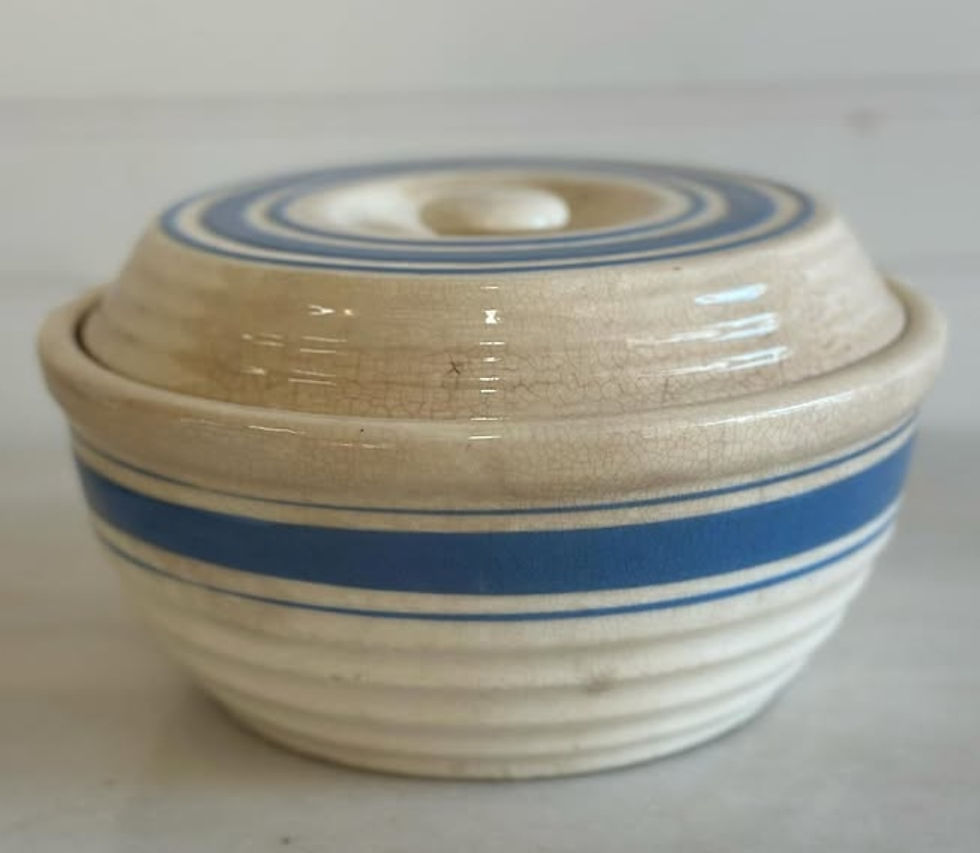
Matching lids are especially important to collectors today.
A surviving bottom may be relatively easy to find, while locating the correct matching lid can turn into an entirely separate hunt.
Hull No. 300/14 — Custard Cup
Documented size: 3"
The Custard Cup measures only 3 inches according to the price list.
Even more interesting, Hull's period advertising shows the little cups arranged together in a serving rack.
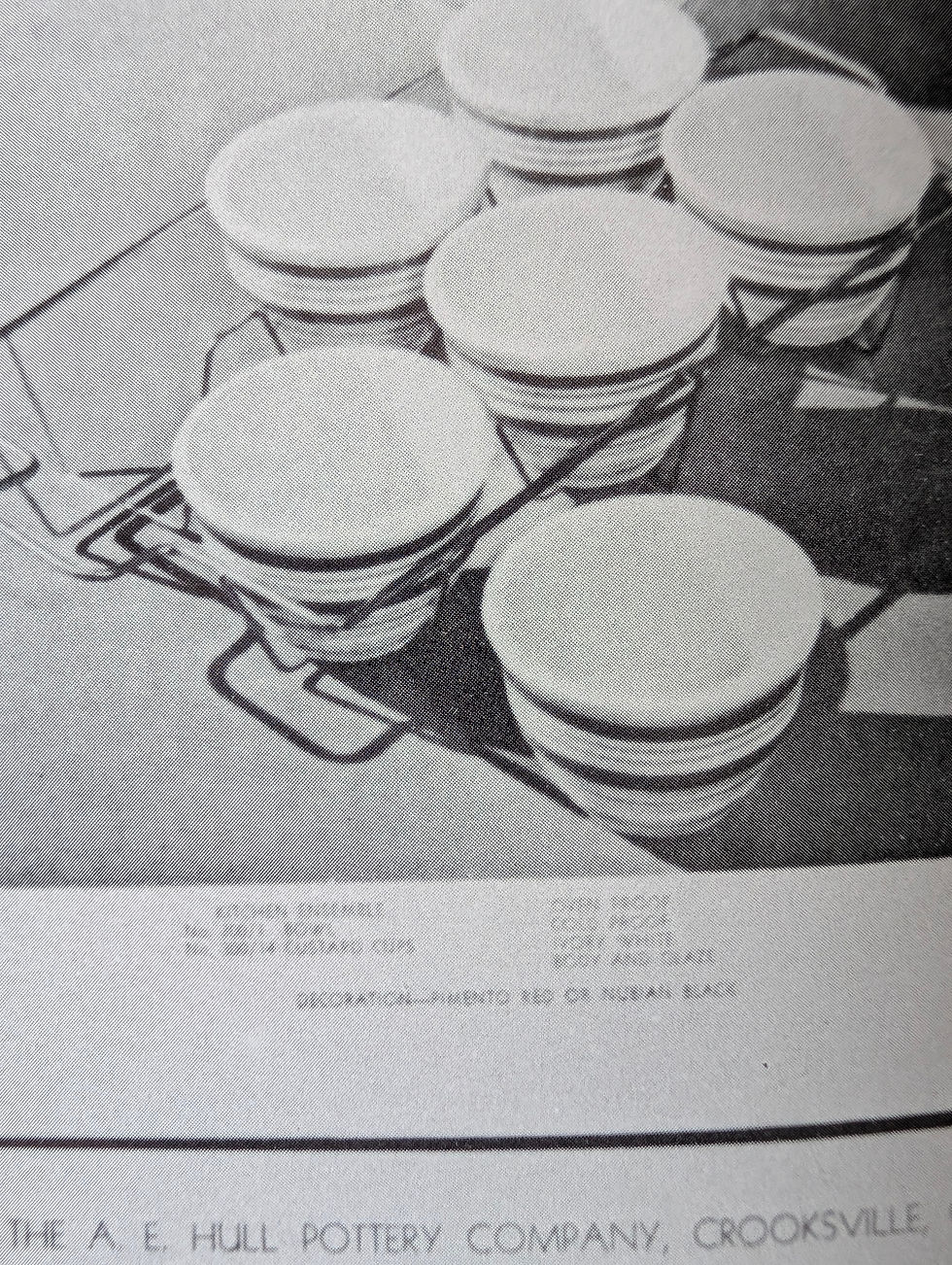
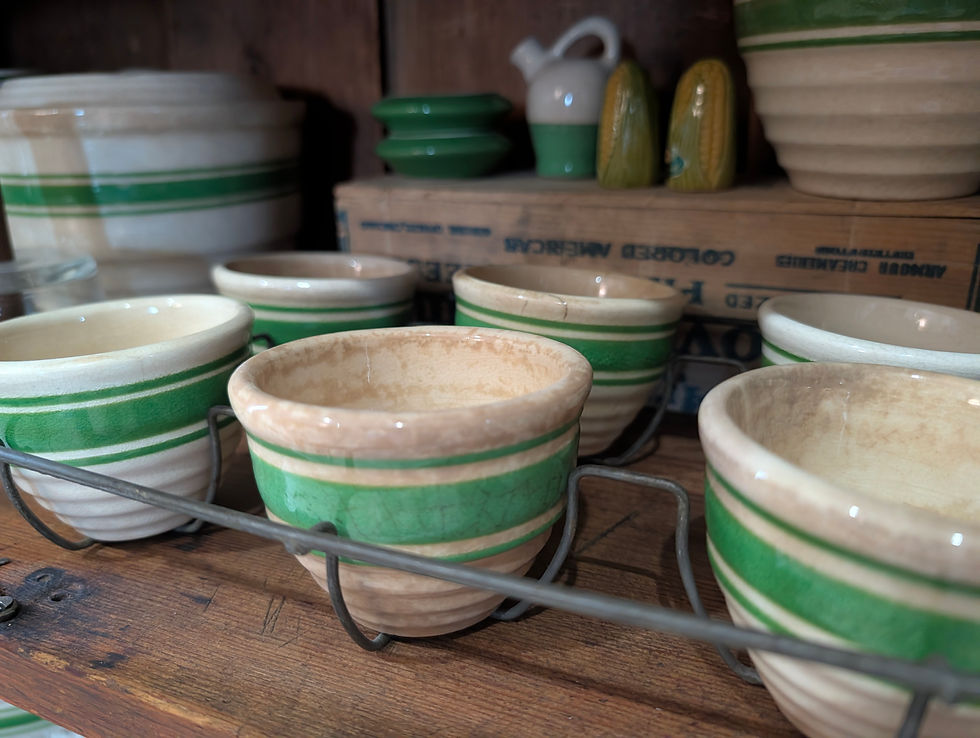
This is one of those pieces that even experienced Hull collectors may not immediately recognize as belonging to the 300 Line.
Hull No. 300/15 — French Casserole
Documented sizes: 4" and 5"
Hull specifically called these little handled dishes French Casseroles.

Hull No. 300/16 — Plate
Documented size: 7"
The 1935 list documents a 7-inch Plate as part of the line. I have never seen or found one of these plates.
Hull No. 300/17 — Baked Apple
Documented size: 5"
Yes — Hull actually cataloged a specialized piece as Baked Apple.
These purpose-specific dishes are one of my favorite things about researching vintage kitchenware.
They tell us not only what people owned, but also something about the way meals were prepared and served.
Hull No. 300/19 — Covered Bean Pot
Documented sizes: 3", 4", 5", 6", and 7"
Hull offered an impressive five sizes of Covered Bean Pot.
Period advertising shows the bean pot filled and ready for the table.

Why Are Hull Beehive Pieces Sometimes Misidentified?
Vintage striped kitchenware can be tricky.
Hull was not the only American pottery company to produce ribbed bowls or simple banded kitchenware.
Because of that, color alone is not enough to identify a piece as Hull.
Instead, compare several characteristics together:
Overall shape and proportions
Horizontal ribbing
Rim shape
Handle design
Lid profile
Stripe placement
Exact measurements
Base markings, when present
Similarity to documented Hull catalog forms
The period catalog photographs are especially valuable.
A green stripe does not automatically make a piece Hull.
A green-striped piece whose size and shape match a documented Hull 300 Line form is much stronger evidence.
How Much Did Hull 300 Line Pottery Cost in 1935?
Another fascinating detail on the October 1935 price sheet is the original wholesale pricing.
Prices were given by the dozen, not as individual retail prices.
For example, some of the smallest pieces cost the retailer little more than a dollar per dozen, while larger bowls, bean pots, casseroles, and jugs cost several dollars per dozen.
Those figures sound incredibly low today, but this pottery was not being marketed as rare art pottery.
It was useful household ware.
It was meant to work.
The bowls were mixed in.
The pie plates baked pies.
The casseroles held supper.
The pitchers poured.
The bean pots were filled.
That everyday use is one reason genuinely clean examples can be difficult to find nearly ninety years later.
A little crazing, worn striping, utensil wear, or other evidence of age can be part of the story of a piece that spent decades doing exactly what Hull made it to do.
Can You Still Cook With Vintage Hull Pottery?
Period Hull advertising clearly presents these pieces as functional kitchen and serving ware.
That tells us what Hull intended when the pottery was new.
It does not necessarily mean that an approximately 90-year-old piece should automatically go into a modern oven today.
Before using vintage pottery for food or heat, consider factors such as:
Age
Crazing
Hairline cracks
Previous repairs
Unknown glaze condition
Thermal shock
Modern food-safety expectations
For rare or especially nice examples, I personally think display is a wonderful retirement plan.
There are plenty of modern casserole dishes.
There aren't any factories making original 1935 Hull 300 Line pottery.
Collecting Hull Beehive Pottery Today
One of the reasons I love this pottery is that there is no single "right" way to collect it.
You can collect one color.
You can collect nesting bowls.
You can search for every documented size.
You can specialize in pitchers or covered forms.
Or you can simply pick up the pieces that speak to you.
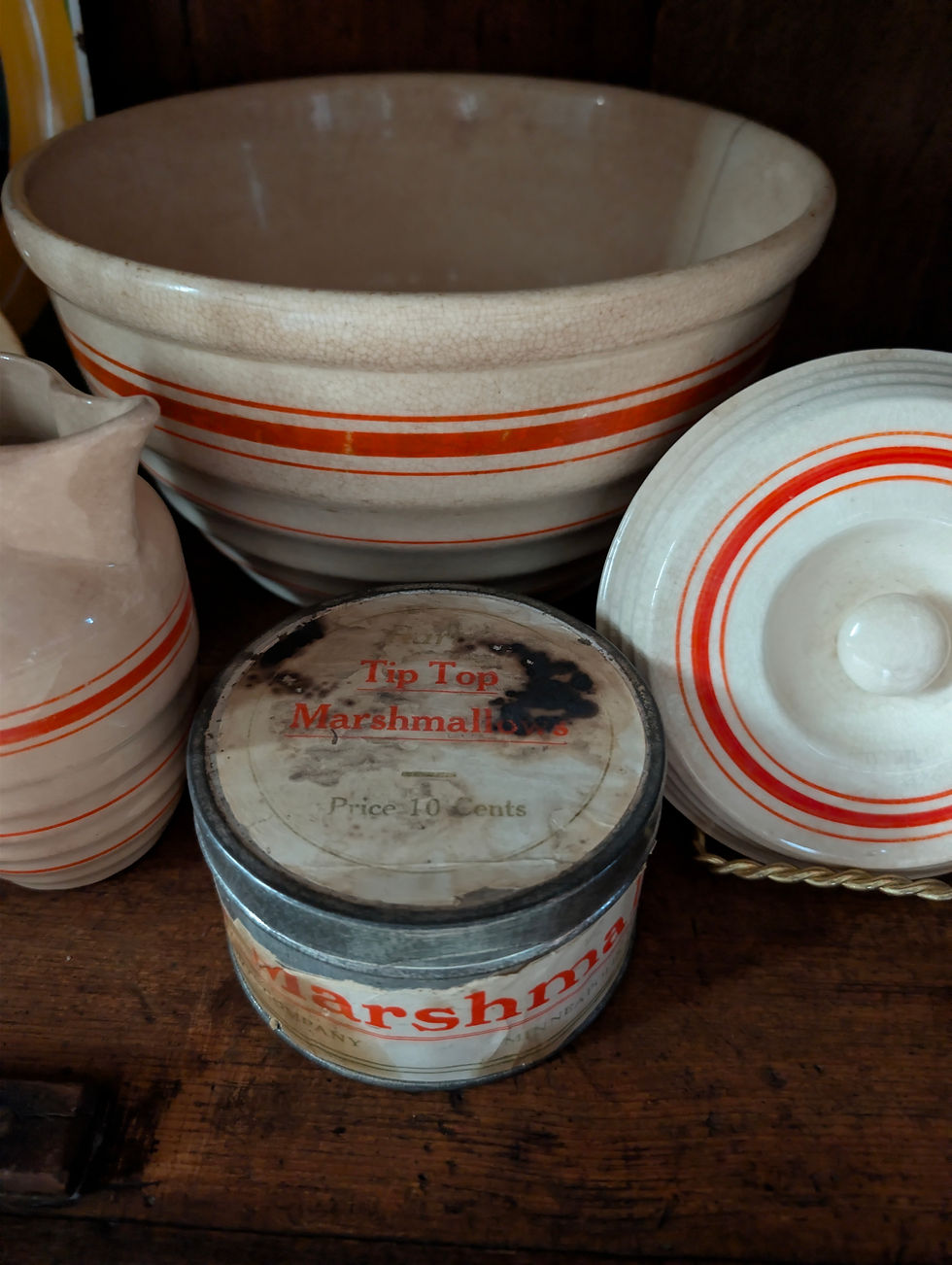
A cabinet filled with green stripe pieces makes a fantastic vintage kitchen display.
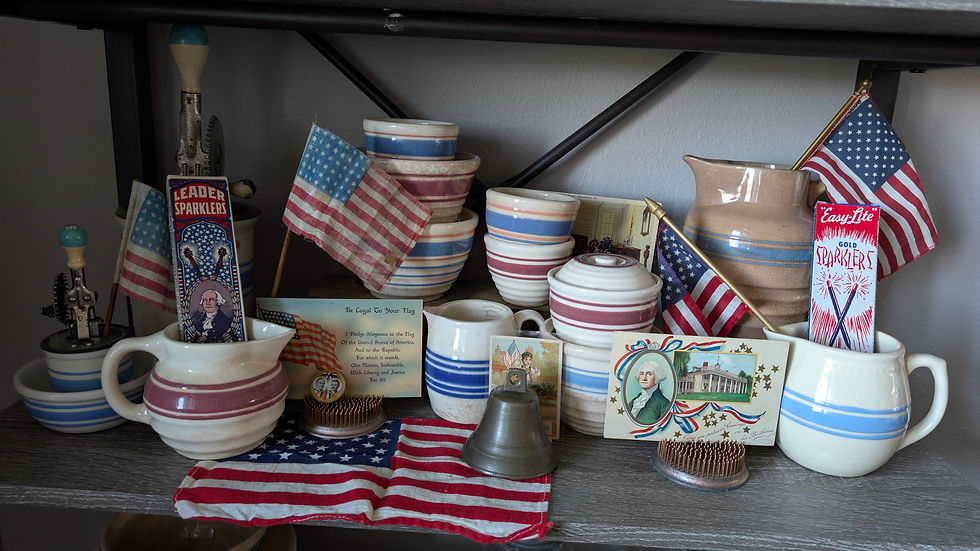
The red and blue examples work beautifully with Americana.
And the warm ivory body pairs naturally with old wood, primitive kitchen tools, vintage advertising, stoneware, and other early household pieces.
The Hunt Is Part of the Fun
Once you realize how extensive Hull's 300 Line really was, antique shopping changes a little.
That small ribbed dish on the bottom shelf suddenly deserves another look.
So does the little pitcher.
And that lidded piece sitting behind the mixing bowls might be far more interesting than you first thought.
The common nesting bowls are only the beginning.
A collector trying to assemble every documented form and size has 34 different size/form combinations represented on the October 1935 price list alone.
And trying to complete those combinations in a single color?
That could keep someone hunting for a very long time.
But the reality is, the hunt is part of the fun, dishing out loads of money for an instant collection is not as enjoyable as searching high and low for all the pieces at fair prices.
Final Thoughts
Hull Pottery is remembered today for many wonderful things, including colorful art pottery, floral designs, novelty ware, and other highly collectible lines.
But the company's earlier kitchenware deserves attention too.
What collectors commonly call Hull Beehive pottery represents a fascinating part of Hull's utilitarian history.
And thanks to surviving company material, we can document much of the collection by its original designation:
A. E. Hull Pottery Company — 300 Line Kitchen Ware
Documented October 1, 1935.
We know the original stripe colors.
We know the catalog numbers.
We know the sizes.
And we know that this was far more than a set of mixing bowls.
If you collect Hull Beehive pottery, save or bookmark this page. I plan to continue learning about the line and adding information as additional pieces and original references surface.
There may still be another piece out there waiting for your collection.
Happy hunting!
Quick Hull Beehive Collector Reference
This is a quick reference based on the documentation I have found. There can easily be more or less in all the different colors, like I believe I have a 10" mixing bowl that isnt listed. If you have found an item that isn't listed I would love to see it and add it to the reference.
No. | Item | Size(s) |
300/1 | Bowl | 5", 6", 7", 8", 9" |
300/4 | Deep Bowl | 4", 5", 6", 7" |
300/6 | Bake Dish | 4", 5", 6", 7", 8", 9" |
300/7 | Jug | ¾ pt., 1 pt., 1 qt. |
300/9 | Ramekin | 4" |
300/12 | Pie Plate | 9", 10" |
300/13 | Covered Casserole | 6", 7", 8" |
300/14 | Custard Cup | 3" |
300/15 | French Casserole | 4", 5" |
300/16 | Plate | 7" |
300/17 | Baked Apple | 5" |
300/19 | Covered Bean Pot | 3", 4", 5", 6", 7" |
Documented Stripe Colors
Pimento Red — overglaze
Nubian Black — overglaze
Spring Green — underglaze
Alice Blue — underglaze
Red/Orange
Research & References
The primary source for the Hull 300 Line item numbers, forms, sizes, stripe color names, and October 1, 1935 date used in this article is the period A. E. Hull Pottery Company material reproduced in the photographs on this page from the book "The Collector's Encyclopedia of Hull Pottery" by Brenda Roberts.
Additional historical information about the A. E. Hull Pottery Company can be found through the Zanesville Museum of Art and the Mid-America Stoneware & Pottery Club.

Comments